Stellated Dice

While popularised in the mid-70s with the original Dungeons & Dragons, the humble D20 in its icosahedral form has existed for almost two millennia. That basic design, and others in the now standard RPG gaming set, have endured because they function as fair dice (more on that later) and are easy to manufacture.


Almost all RPG dice sets are based on these designs, varying mainly in colour, material, and decoration. Is it possible to have real innovation in RPG dice design? A few have tried with improved number layouts, but practically always with the same shapes.


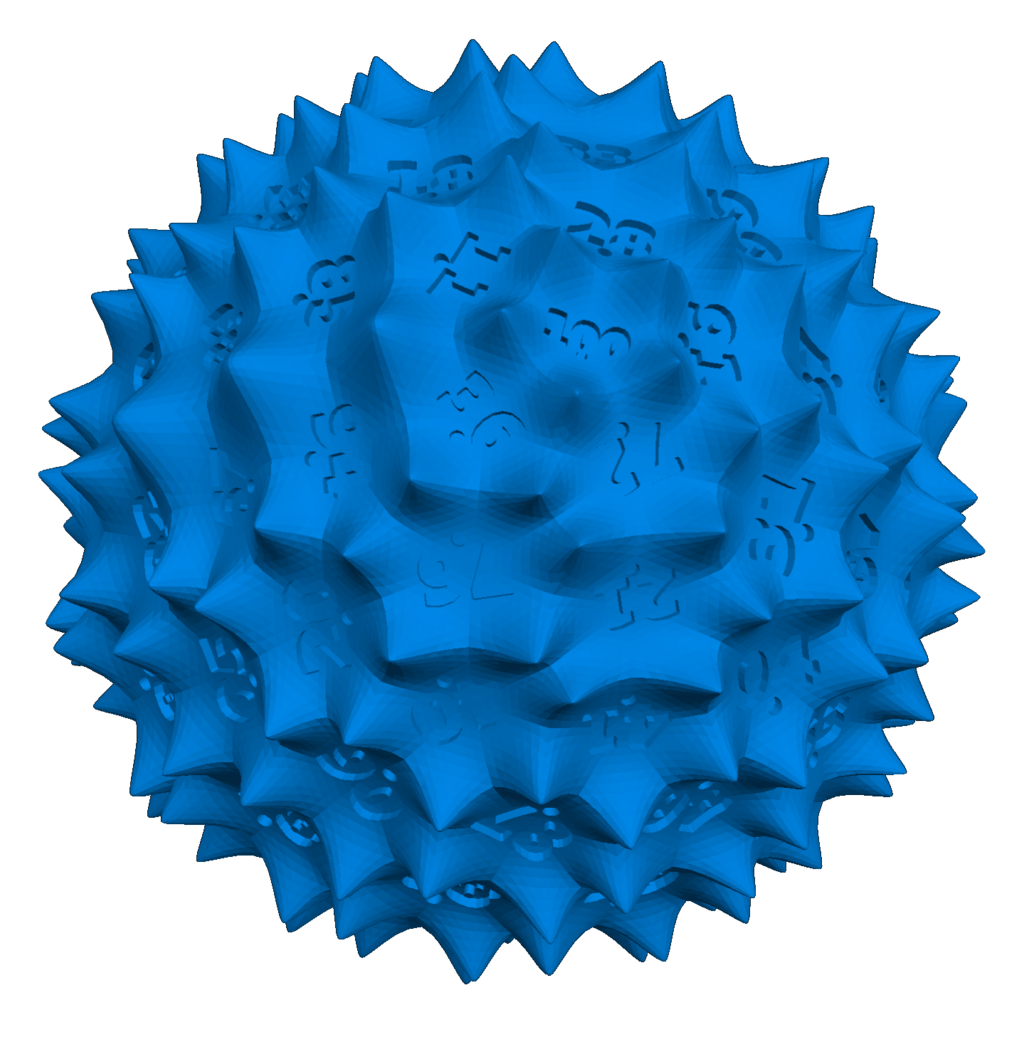
Introducing the Hero's Gambit set of stellated dice! They've been radically redesigned with organically inspired shapes, not just for aesthetics but with real-world physical benefits. They also feature provably better number layouts, with in-built protections against both oblate and imbalance manufacturing flaws, to ensure the fairest possible dice rolls.


I am currently having prototypes manufactured and will update here with plans for public sales.


Add your contact details to THIS FORM to be notified when the dice are ready to be manufactured.

Curvy & spiky

The first thing you notice is the shape. Spiky. Curvy. Spiky and curvy! They are unlike any dice you have seen before.


Granted, they look cool, but there's more to it that simply looks. The spikes extend the dice's effective radius, providing a broader, stabler, base. Rolls are shorter, quicker, and more sure footed.


This set includes the standard seven RPG dice types: d20, d12, d10 (0-9), d10 (00-90), d8, d6, and d4.


They also look cool.

Balanced by design

The standard number layout found on almost all RPG dice sets makes only a token attempt at balanced design. That's to be expected given most of these designs were laid down over 50 years ago. The computational power to optimally balance the number layout just didn't exist.


Since then, a few dice vendors have made improved number layouts. These typically involve calculating equal hemisphere totals (all possible halves of the dice being as equal as possible) and/or equal vertexes (all grouped faces on adjacent vertexes being as equal as possible). While these layouts do produce much better results, they each have trade-offs and benefits.


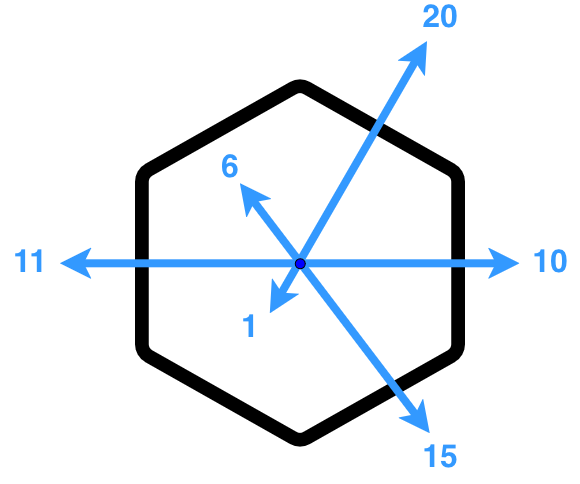
I've used a different strategy to derive the optimal number layout, based on balancing the vectors of the opposing number dipoles. Imagine the typical 20-opposite-1 arrangement. That produces a vector pulling the numerical centre of gravity away from the dice's physical centre of gravity. By carefully arranging the number dipoles we can produce a dice whose vectors cancel out and the physical and numeric centres of gravity are as aligned as possible.


The result is a state-of-the-art dice that provides innate oblate (squished, equally favouring opposite sides) protection and imbalance (weighted, favouring one side) protection, measurably better than previous designs.
Big Daddy

Inspired by the 1985 design of the Zocchihedron by the late Lou Zocchi, this is a stellated version for a 100-sided dice.


But while Lou's Zocchihedron featured a system of internal weights to slow its inevitable roll off the edge of the table, our stellated design results in a well behaved dice. It rolls, and stops, as you desire, not as you'd expect.


The Pemberhedron (hey, if Lou can do it why can't I?) also benefits from the same dipole-balanced number layout as the rest of the range of stellated dice. This ensures that, regardless of any subtle imbalances, the dice rolls as fairly as possible.


Achieving this balance required some serious computational modelling, as the potential number layouts approximates the number of atoms in the observable universe!

That's over thirty-four quinvigintillion (yes, that's a real word!) potential combinations.

Funky Boy

Based on the same optimised number layout, this version of the d20 presents a funky, knobbly, profile.


As in the rest of the stellated designs, the numbers are safely ensconced deep in the valley between the protective spikes, or rather, knobs in this version. Groovy!


Is it better or worse? That's up to you!

The Pervert

Have you ever seen a dice that's just wrong?


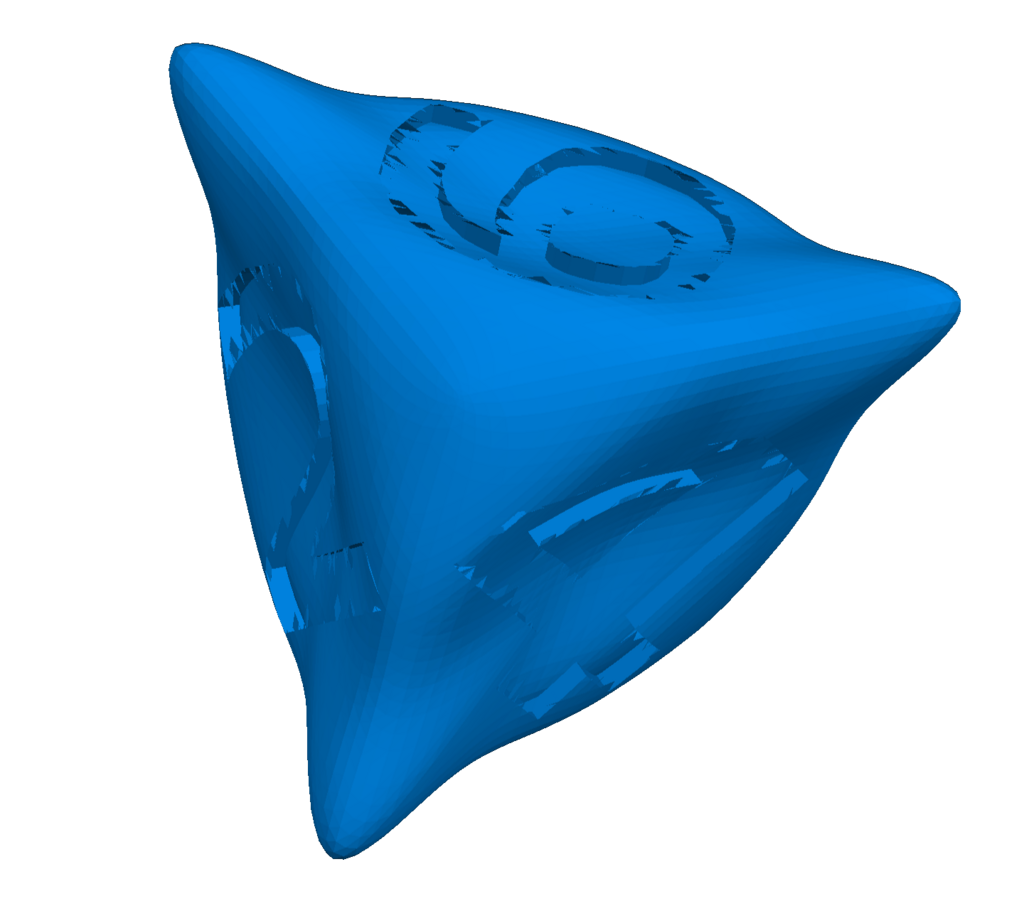
Created in a dark ritual of 3D modelling and topological googling - behold the triangular d6!


Cast out by the dice gods, the design is based on a edge-numbered, distended, triakis tetrahedron. It fairly rolls 1 to 6 just like a normal d6, but in the hand and to the eye seems almost pyramidal.


Horrify your friends with this monstrosity!